
Holding a newborn for the first time can feel overwhelming. Their tiny body, floppy head, and delicate features make many parents and caregivers anxious about doing it wrong. While it’s natural to want to cradle your baby close, knowing how not to hold a newborn baby is just as important as learning the right way. Incorrect handling can lead to strain, discomfort, or even injury—especially to their developing neck and spine.
The truth is, no one expects you to be perfect right away. It takes practice, patience, and awareness. But avoiding common mistakes from the start can protect your baby and build your confidence. In this guide, you’ll learn the unsafe ways to hold a newborn, why they’re risky, and what to do instead. From unsupported heads to awkward feeding positions, we’ll walk through exactly what to avoid—and how to keep your baby safe, supported, and secure.
Failing to Support the Head and Neck
Newborns cannot hold up their heads due to underdeveloped neck muscles. One of the most serious mistakes is lifting or holding them without proper head support.
Why This Is Dangerous
A newborn’s head makes up about 25% of their body weight. Without support, sudden movements can cause brain or spinal injuries. Even mild bouncing can lead to internal damage.
Signs of Poor Head Support
- The baby’s head lolls backward or sideways
- Their chin touches their chest or tilts too far back
- You have to grab their head after lifting
Always place one hand under the head and neck when picking up your baby, especially in the first 3–4 months.
Lifting a Baby by the Armpits
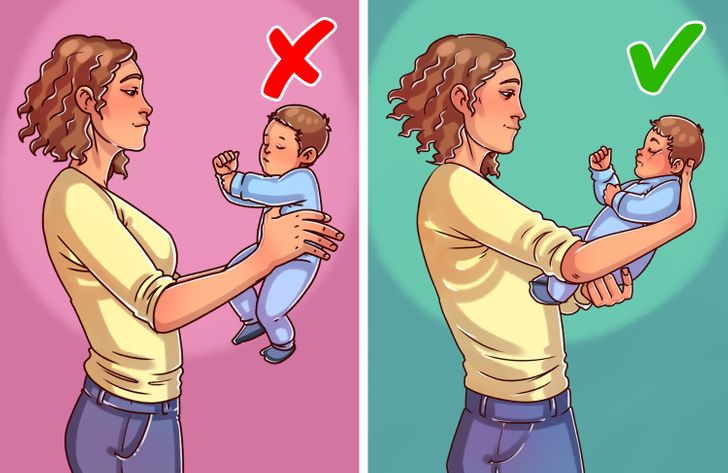
Pulling a newborn up by their arms or underarms may seem convenient, but it poses real health risks.
Why This Harms Your Baby
Babies’ joints and ligaments are fragile. Yanking them by the arms can cause nursemaid’s elbow, where the elbow ligament slips out of place. Though more common in older infants, the risk begins early.
Safer Way to Lift
- Slide one hand under the head and neck
- Use the other to support the bottom
- Lift smoothly and close to your chest
Never swing or dangle a newborn by the arms, even during play.
Holding a Newborn Too Loosely
A loose grip—especially without full back and head support—increases the risk of slips and falls.
Risks of an Unstable Hold
- Accidental dropping when distracted or tired
- Sudden neck strain from shifting weight
- Spinal misalignment
How to Test Your Hold
- Can you stay in control if jostled?
- Is the head resting securely against your arm or chest?
- Are both the head and bottom fully supported?
Keep your baby close to your body at all times for maximum safety.
Using Only One Hand to Carry
Trying to multitask while holding a newborn with one hand is a common but dangerous habit.
Risky Scenarios to Avoid
- Holding the baby while opening doors or grabbing items
- Carrying them under one arm like a football before neck control develops
- Reaching for something while the baby is loosely cradled
Why Two Hands Are Essential
One-handed holds reduce reaction time and balance. Even a small stumble can lead to injury.
Proper Two-Hand Technique
Use both hands every time:
• One hand under the head and neck
• The other under the buttocks and lower back
After 3–4 months, brief one-handed holds may be safe—but only if the head remains supported.
Holding Baby Face-Down on Your Arm Without Support
The football hold can be safe for burping or feeding—but only with correct technique.
When This Position Becomes Dangerous
- The head is not elevated or supported
- The spine is bent or twisted
- The neck dangles or turns awkwardly
This can restrict breathing and strain the airway.
How to Use the Football Hold Safely
If using this position:
• Tuck the baby under your arm with their head in your palm
• Align their body along your forearm, legs behind your elbow
• Keep the head slightly higher than the chest
• Never leave unattended
Avoid this hold in the first few weeks unless supervised or experienced.
Shaking or Bouncing Too Vigorously

Some caregivers shake or bounce babies to soothe crying—but this can be life-threatening.
The Risk of Shaken Baby Syndrome
Shaking a newborn—even briefly—can cause brain damage, blindness, or death. Their brains move loosely in the skull and are easily injured.
Common Dangerous Actions
- Fast rocking in a chair
- Jiggling during crying spells
- Tossing the baby gently into the air
These may feel harmless but can cause serious harm.
Safe Alternatives for Soothing
• Gentle side-to-side rocking
• Slow walking with baby snug against your chest
• Steady patting on the back
Rule of thumb: If it would make your head dizzy, it’s too rough for your baby.
Holding Baby at Arm’s Length
Some people hold newborns far away out of fear or for better visibility—but this increases fall risk.
Why Distance Is Risky
- Reduces your ability to react to shifts in balance
- Makes head support harder during movement
- Increases chances of dropping when turning or sitting
The Close-Body Rule
Always keep the baby within your center of gravity:
• Chest-to-chest contact provides warmth and security
• Arms close to your torso improve control
• You can respond instantly to movement
Think of holding them like hugging in a crowd—keep them close and protected.
Forcing a Baby Into a Full Upright Position
Holding a newborn completely upright without support can cause discomfort and physical strain.
Why This Is Harmful
- Newborns lack core strength to sit independently
- Unsupported upright posture can compress the spine
- May trigger reflux or spitting up
Safe Upright Holding for Burping
To safely hold baby upright:
• Support the head and neck with one hand
• Use the other to support the bottom and back
• Keep the chin slightly elevated, not tucked
• Lean them slightly forward, not straight up
Limit upright time to 5–10 minutes per session.
Unsafe Feeding Positions That Mimic Poor Holding

Even during feeding, improper holds can cause choking, strain, or poor latching.
1. Feeding While Baby Lies Flat
Placing a baby flat on their back to feed increases the risk of choking or ear infections.
Fix It: Always hold the baby at a 30–45 degree incline during feeding.
2. Stretching the Baby’s Neck to Reach the Breast or Bottle
If the baby has to crane their neck forward, it creates strain and poor feeding mechanics.
Fix It: Bring the baby up to the level of the breast or bottle—never lower the source to the baby.
3. Using the Football Hold Without Head Support
While useful after C-sections or for twins, this position requires full head alignment.
Fix It: Keep the baby’s head in your palm and spine straight.
What to Do Instead: Safe Newborn Holding Basics

Now that you know how not to hold a newborn baby, here’s how to do it right.
The 4 Golden Rules of Newborn Holding
• Support the head and neck at all times – Use one hand under the head when lifting
• Keep the baby close to your body – Prevents falls and strengthens bonding
• Use two hands whenever possible – One under the head, one under the bottom
• Move slowly and gently – Sudden motions can startle or injure
Recommended Safe Positions
| Position | Best For | Key Tips |
|---|---|---|
| Cradle Hold | General holding, bonding | Head in crook of arm, body along forearm |
| Cross-Cradle Hold | Breastfeeding | Opposite arm supports head for better latch |
| Laid-Back Nursing | Early feeding, skin-to-skin | Baby lies belly-to-belly, self-attaches |
| Upright Hold | Burping, reflux relief | Head over shoulder, hand supports head and back |
Key Takeaways for Safely Holding Your Newborn
Avoiding dangerous holds is essential for protecting your baby’s development. The first few months are critical for spinal and brain growth, and improper handling can cause lasting harm. Always support the head and neck, use two hands, and keep movements slow and controlled.
Trust your instincts, but back them with knowledge. Watch experienced caregivers, ask for help, and never hesitate to double-check your technique. By learning how not to hold a newborn baby, you’re taking a powerful step toward becoming a confident, safe, and loving caregiver.
Frequently Asked Questions About How Not to Hold a Newborn Baby
Can holding a newborn wrong cause brain damage?
Yes. Shaking or jostling a baby can lead to shaken baby syndrome, which may cause brain damage, blindness, or death. Even vigorous bouncing can be dangerous due to their fragile brain structure.
Is it safe to hold a newborn by the arms?
No. Lifting or swinging a newborn by the arms can cause nursemaid’s elbow or joint injuries. Always support the head and bottom when lifting.
Should I worry about touching the soft spot on my baby’s head?
No. The fontanelle (soft spot) is protected by a tough membrane. It’s safe to touch during normal holding and care, as long as you support the head.
Can poor holding cause spinal injury in newborns?
Yes. Unsupported neck and spine positions can strain developing muscles and ligaments. Always keep the head aligned with the body and avoid forcing upright postures.
Is it okay to carry a newborn in one hand?
Only if the head is fully supported and the baby is close to your body. Two hands are strongly recommended, especially before 3–4 months when neck control develops.
How long should I support my baby’s head?
Support the head and neck until your baby can hold it steadily on their own—typically around 3 to 4 months of age. Every baby develops at their own pace.





