
Watching your baby take their first bite of solid food is exciting—but teaching them how to use a spoon is what turns that moment into lasting independence. Starting as early as 4–6 months, you can begin building the fine motor skills and hand-eye coordination needed for self-feeding. With the right tools, consistent practice, and a mess-friendly mindset, you’ll help your baby progress from grabbing a spoon to confidently scooping food on their own. This guide breaks down every stage of learning, from sensory play to mastery, so you know exactly what to do—and when—to support your child’s development.
You’ll learn how to choose the best baby spoon, when to introduce dipping and scooping, and how to model eating so your baby imitates you. We’ll also cover common mistakes to avoid and how to pair spoon practice with finger foods and cup skills. By the end, you’ll have a clear, step-by-step plan to make mealtime a powerful learning experience.
Start Spoon Practice Before Solids Begin
Begin at 4–6 Months with Spoon Exploration
Start introducing the spoon 4–6 weeks before your baby eats solid food. Even if they’re not ready to eat yet, letting them hold, chew, and bang a soft spoon during mealtime builds familiarity and reduces resistance later. This early exposure aligns with the development of hand-to-mouth coordination, a key milestone at this age.
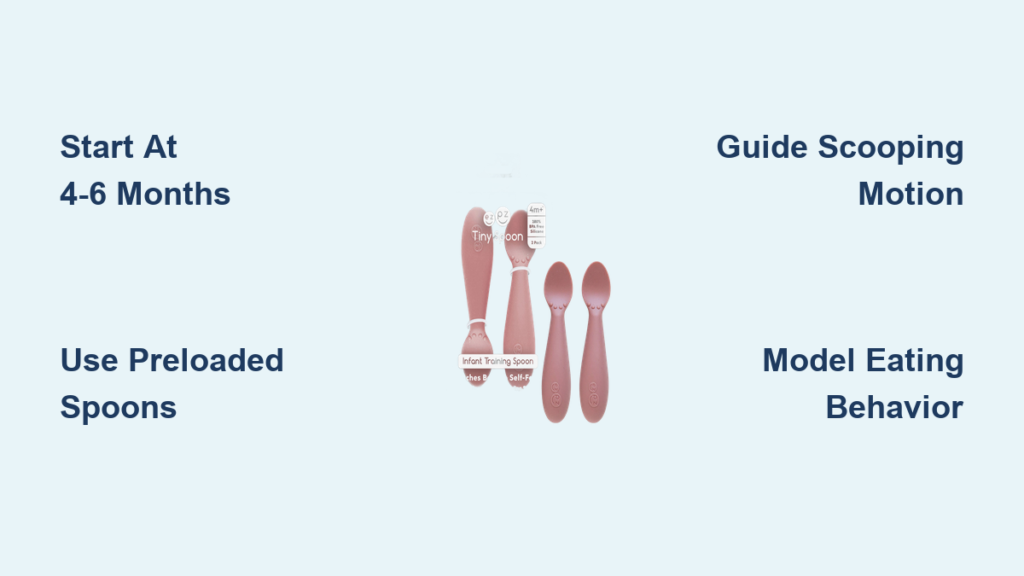
Place a safe, silicone spoon like the ezpz Tiny Spoon on their high chair tray during family meals. Let your baby explore it freely—this sensory play strengthens grip, teaches cause and effect, and supports cognitive growth.
Pro tip: Use mealtime as a dual-purpose activity. While you eat, your baby explores. No pressure, just practice.
Choose the Right Spoon for Tiny Hands
Not all spoons work for beginners. The ezpz Tiny Spoon is designed specifically for early self-feeders and offers three key benefits:
• A short, round handle that fits perfectly in small hands
• Sensory bumps near the bowl to help babies feel how far the spoon goes into their mouth
• 100% food-grade silicone—safe for gums and emerging teeth
Keep a two-pack on hand so one spoon is always preloaded while your baby uses the other. This keeps meals moving and reduces frustration.
Avoid long-handled or metal spoons—they’re harder to grip and can hurt tender mouths.
Pair with a Learning-Friendly Bowl
Use a low-sided, non-slip bowl like the ezpz Mini Bowl. Low sides make it easier for little hands to reach food, and wide handles help babies stabilize the bowl while practicing.
You can prop a preloaded spoon against the bowl’s edge, giving your baby visual and physical access to grab it independently.
Step 1: Use Preloaded Spoons at 6 Months
Hand Over Preloaded Spoons During Meals
At 6 months, when solids begin, shift from exploration to active feeding. Start by preloading a spoon with puree and handing it to your baby while they hold the handle.
Use hand-under-hand guidance to support their movement:
- Place your hand under theirs from the side
- Gently guide their hand toward their mouth
- Let them do the final motion—inserting the spoon themselves
This technique builds muscle memory without taking over. It encourages independence while ensuring success.
Visual cue: If your baby reaches for the spoon or your hand during feeding, they’re ready to try.
Encourage Independent Attempts
Place the preloaded spoon on the tray or prop it in the bowl. Your baby will start reaching, grabbing, and attempting to bring it to their mouth.
Even if they miss or spill, it’s progress. At this stage, a few bites per meal is normal. Remember: solids are still complementary to breastmilk or formula.
Common mistake: Don’t pull the spoon away if they miss. Let them try again. Persistence builds skill.
Step 2: Teach Dipping and Scooping at 7–8 Months
Guide the Full Scooping Motion
By 7–8 months, your baby is ready to learn how to dip and scoop food from the bowl. This requires more coordination than using a preloaded spoon.
Use hand-over-hand support:
- Hold the spoon with your baby’s hand
- Place your hand under theirs for lift support
- Use your thumb on top to stabilize the spoon
- Gently support their elbow to control movement
- Guide them to dip, scoop, lift, and bring food to their mouth
Move slowly and let them feel the weight of the food. This builds motor planning and control.
Gradually Reduce Assistance
With daily practice, reduce your help over time. One day you support the elbow, the next just the wrist. Soon, they’ll attempt the full motion alone.
Signs of progress:
• They dip the spoon into food (even if empty)
• They lift the spoon toward their mouth
• They open their mouth in anticipation
Pro tip: Use thick purees like mashed banana or oatmeal. Runny foods slide off the spoon and frustrate early learners.
Step 3: Model Spoon Use at 9–10 Months

Demonstrate Eating with Exaggerated Motions
At 9–10 months, most babies are ready to imitate. This is when modeling becomes your most powerful teaching tool.
Sit face-to-face during meals and:
- Hold your own spoon
- Dip it into the bowl
- Scoop food
- Bring it to your mouth with slow, exaggerated motion
Then hand your baby a second spoon and say, “Your turn!”
Even if they hold it upside down or miss their mouth, watching and trying is learning. Repetition refines technique.
Use Parallel Feeding for Social Learning
Let your baby practice while you eat. This “parallel feeding” mimics social learning and keeps them engaged.
Expert note: Imitation is a cognitive leap. If your baby watches intently but doesn’t try, they’re still processing. Don’t rush—just keep modeling.
Step 4: Master Spoon Skills by 12–18 Months
Expect Mess and Celebrate Small Wins
Between 12 and 18 months, your child will go from spoon novice to confident self-feeder. But progress isn’t linear.
At 12 months:
• They likely feed themselves with fingers
• Spoon use is improving but still messy
• They may alternate between fingers and spoon
By 18 months:
• Most children master spoon and fork use with consistent practice
• Spills decrease, accuracy increases
Key takeaway: Mastery varies. Some kids get it by 12 months; others by 18. Both are normal.
Practice Spoon Use at Every Meal
Repetition is everything. Offer the spoon at every meal, even if they resist or regress.
Difficulty indicator: Spoon learning is moderate effort—expect 2–3 months of active teaching before consistent success.
Time-saving shortcut: Preload spoons during the learning phase to keep meals moving while still encouraging participation.
Introduce the Fork Only After Spoon Mastery

Wait Until 12 Months to Start
Forks are more complex than spoons. They require piercing food before lifting—demanding greater precision.
Only introduce the fork after your baby masters:
• Dipping and scooping
• Bringing food to mouth
• Eating most of a meal independently with a spoon
Start with Soft, Piercable Foods
Use the ezpz Mini Fork (designed for 12+ months) and offer soft, bite-sized foods:
• Cooked carrots
• Mashed potatoes
• Steamed broccoli florets
Let them practice piercing and lifting. At first, they may stab and drop—but that’s part of learning.
Safety note: Never leave a child unattended with a fork. Supervise all meals.
Support Spoon Skills with Finger Foods

Build Fine Motor Skills Early
Before spoons, babies learn with finger foods. Offering soft, pick-up-sized pieces helps develop pincer grasp and hand-eye coordination.
Examples:
• Small cooked noodles
• Soft fruit cubes (banana, avocado)
• Toast strips
By 12 months, your child should easily feed themselves with fingers—a prerequisite for utensil success.
Combine Fingers and Spoons at Meals
Don’t eliminate finger foods when introducing spoons. Let your baby use both. This builds confidence and ensures they get enough to eat while learning.
Red flag: If your child refuses all finger foods or shows no interest in self-feeding by 10 months, consult a pediatrician or feeding specialist.
Teach Cup Skills Alongside Spoon Use

Offer Sippy and Straw Cups at 6 Months
Drinking skills develop alongside eating. At 6 months, introduce:
• A sippy cup with a spout
• Or a straw cup
Let them explore during meals. At first, they may just chew the straw—but that’s okay.
Try Open Cups at 9 Months
By 9 months, many babies can handle an open cup with help. Use a small, lightweight cup and support their hands.
Start with sips of water during meals. Spills are expected—use a bib and tray liner.
Why it matters: Cup skills reinforce hand control and oral motor development, supporting spoon use.
Avoid These Common Spoon-Teaching Mistakes
Never Feed Cereal from a Bottle
Safety warning: Do not give cereal or solid foods from a bottle. It increases choking risk and can lead to overfeeding.
Use a spoon for cereals, purees, and mashed foods—even if it’s messier.
Don’t Take Over Feeding
It’s tempting to swoop in and “help” by feeding them yourself. But let your baby lead.
If you do it for them, they lose motivation to learn. Guide, don’t control.
Skip the Pressure
Never force your baby to use a spoon. If they resist, go back to preloading or parallel play. Stress kills progress.
Urgency note: This isn’t a race. Every baby develops at their own pace.
Key Principles for Teaching Spoon Use Successfully
Start Early and Stay Consistent
The earlier you begin—4–6 months—the smoother the transition to self-feeding. But consistency matters more than timing.
Practice at every meal, even if progress seems slow.
Use Developmentally Designed Tools
The right spoon makes all the difference. The ezpz Tiny Spoon is engineered for early learners:
• Perfect size
• Sensory feedback
• Safe material
Pair it with a supportive bowl and two-spoon system for best results.
Be Patient and Positive
Mastery takes 6–12 months of active practice. Celebrate small wins:
• First successful scoop
• First self-fed bite
• First attempt to dip
Your encouragement builds confidence.
Frequently Asked Questions About Teaching Baby to Use Spoon
When should I start teaching my baby to use a spoon?
Begin spoon exploration at 4–6 months, 4–6 weeks before starting solids. At 6 months, start offering preloaded spoons during meals. Most babies begin mastering dipping and scooping between 7–8 months.
What kind of spoon is best for a baby learning to self-feed?
The ezpz Tiny Spoon is the top choice. It has a short, round handle for tiny hands, sensory bumps to guide mouth depth, and is made of 100% food-grade silicone. A two-pack ensures one spoon is always ready.
How do I teach my baby to scoop food with a spoon?
Start with thick purees. Use hand-over-hand guidance: support their hand and elbow to dip, scoop, and lift. Gradually reduce help as they gain coordination. Practice daily for best results.
Should I stop finger foods when teaching spoon use?
No. Continue offering finger foods alongside spoons. Babies need both to build confidence and ensure they eat enough. Finger feeding supports the fine motor skills needed for utensil use.
What if my baby refuses to use a spoon?
Go back to preloading or parallel play. Let them watch you eat and explore the spoon during play. Never force it—pressure slows progress. Try again in a few days.
Can I introduce a fork before a spoon?
No. Always teach spoon use first. Forks require more precision and should only be introduced after spoon mastery, typically around 12 months.
Key Takeaways for Teaching Your Baby to Use a Spoon
Learning how to teach baby to use spoon starts early and grows with consistency, the right tools, and positive reinforcement. Begin spoon exploration at 4–6 months, use preloaded spoons at 6 months, and guide dipping and scooping by 7–8 months. Model eating at 9–10 months, and expect mastery between 12–18 months.
Use the ezpz Tiny Spoon and Mini Bowl for best results, combine spoon practice with finger foods, and avoid common mistakes like taking over or feeding from a bottle. Every spill is a step forward—celebrate the mess, stay patient, and keep offering opportunities.
Next step: Once spoon skills are solid, introduce the fork. Then, focus on open cup drinking and family-style meals. Each new skill builds confidence and independence at the table.





