
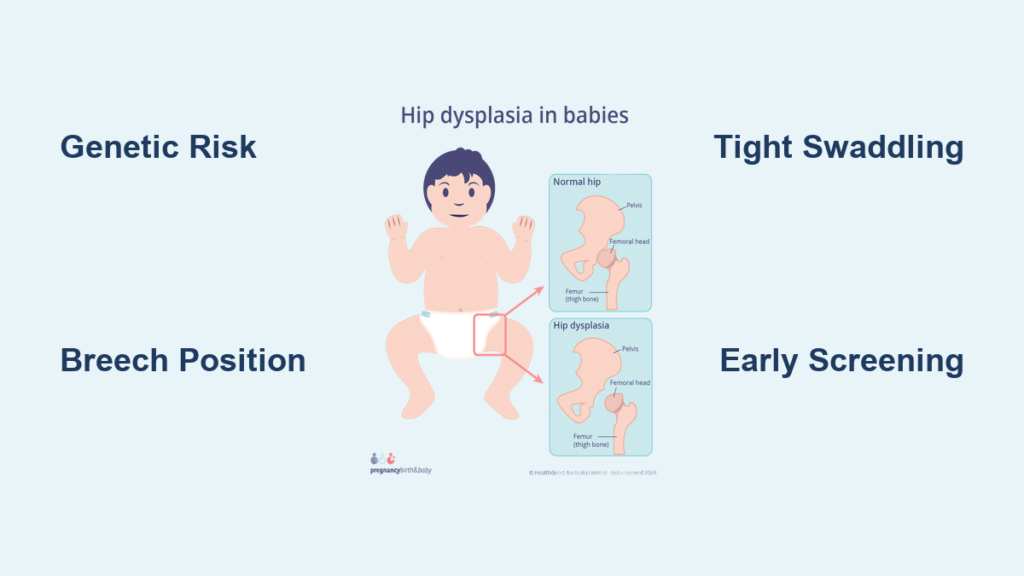
Developmental Dysplasia of the Hip (DDH) occurs when a baby’s hip joint doesn’t form properly, leading to instability or dislocation. The hip, a ball-and-socket joint, relies on a deep socket and tight ligaments to keep the femoral head securely in place. In babies with DDH, the socket is too shallow, the ligaments are loose, or both—allowing the ball to slip partially or completely out. While painless in infancy, untreated DDH can lead to arthritis, limping, and early hip replacement.
About 1 in 1,000 babies is born with hip dysplasia, most commonly first-born girls with a family history or breech positioning. The good news? Over 85% respond well to early treatment, like the Pavlik harness. But how do babies get hip dysplasia? It’s not one single cause—it’s a mix of genetics, maternal hormones, fetal positioning, and postnatal care. This guide breaks down the real causes, signs to watch for, and how early action can prevent lifelong complications.
Genetic Predisposition and Family History
Why Family History Raises DDH Risk
A strong family history is one of the biggest predictors of hip dysplasia. About one-third of babies diagnosed with DDH have a parent or sibling who also had the condition. This points to a genetic link, possibly involving connective tissue structure or joint formation. If you or your partner had DDH as a child, your baby’s risk increases significantly. Even distant relatives with hip issues can signal inherited susceptibility, so sharing your family’s medical history during prenatal visits is crucial.
Inherited Ligament Laxity and Joint Flexibility
Some families pass down traits like loose ligaments, which make joints more flexible. While this flexibility usually resolves in the first few months, in genetically predisposed babies, it can prevent the hip socket from stabilizing. This ligament laxity, combined with other risk factors, increases the chance of persistent hip instability. Most babies outgrow mild looseness, but those with DDH often need intervention to guide proper joint development.
Maternal Hormones and Fetal Ligament Softening
How Relaxin Affects the Baby’s Hips
During pregnancy, the mother’s body produces relaxin, a hormone that loosens her own ligaments to prepare for childbirth. This hormone crosses the placenta and can affect the baby, causing temporary ligament laxity in the developing hips. While usually harmless, in some babies—especially girls, who are more sensitive to these hormones—the hip ligaments remain too loose, increasing the risk of dislocation. This is a key reason why girls are 4–5 times more likely than boys to develop DDH.
Why Hormonal Sensitivity Matters
Female fetuses appear to respond more strongly to maternal hormones, which may explain their higher DDH rates. The combination of hormonal influence and mechanical pressure in the womb creates a perfect storm for hip instability. This sensitivity doesn’t mean every girl will develop DDH, but it does mean parents should be extra vigilant with screening if other risk factors are present.
Breech Position and Restricted Fetal Movement
Why Breech Babies Are at High Risk
Babies in the breech position (bottom-first) have a 10–20 times higher risk of DDH. In this position, the hips are extended and pressed together, limiting natural movement needed for proper socket development. The lack of motion prevents the hip joint from forming deeply, increasing the chance of instability or dislocation. Doctors often monitor breech babies closely, even if the baby is turned before delivery.
How Uterine Crowding Affects Hip Formation
First pregnancies carry higher DDH risk because the uterus is tighter and less stretched, leaving less room for the baby to move. Limited motion means the hips don’t get the natural stimulation needed for healthy development. Other factors that reduce space include:
• Low amniotic fluid (oligohydramnios)
• Multiple babies (twins, triplets)
• Large birth weight (macrosomia)
All restrict fetal movement and can contribute to abnormal hip formation.
Dangerous Swaddling and Postnatal Positioning

How Tight Swaddling Can Cause Hip Dysplasia
After birth, how you wrap your baby matters. Swaddling with the legs straight and pressed together forces the hips into an unnatural position, increasing the risk of dislocation. Research shows that tight wrapping restricts hip movement and interferes with normal joint development. The hip needs to be in a flexed and abducted position—knees bent and spread apart, like a frog—to encourage proper socket formation.
Safe Swaddling Practices to Prevent DDH
Hip-healthy swaddling allows free leg movement. To protect your baby’s hips:
• Use a swaddle that leaves room for the legs to bend up and out
• Ensure knees can spread apart naturally
• Avoid wrapping the lower body too tightly
• Choose wraps labeled “hip-healthy” or “DDH-safe”
Carrying methods like front carriers or slings that support the thighs and keep hips apart also promote healthy development.
Physical Signs Parents Should Watch For
Uneven Skin Folds on Thighs or Buttocks
One of the most visible signs of DDH is asymmetrical skin folds on the thighs or buttocks. If one hip is dislocated, the leg may appear shorter, causing creases to line up unevenly. While not all skin fold differences mean DDH, they should prompt a doctor’s evaluation.
Limited Hip Movement During Diaper Changes
If one leg doesn’t open as far as the other when you spread your baby’s legs, it could signal hip instability. A baby with DDH may resist hip movement or show less flexibility on one side. This reduced range of motion is a red flag, especially if it’s consistent.
Clicking or Clunking Sounds in the Hip
A deep clunk—not just a soft click—when moving the hip can indicate dislocation. While some clicks are harmless tendon snaps, a clunk during leg rotation may point to joint instability. This is especially concerning if detected during the Barlow or Ortolani maneuver by a doctor.
Uneven Knee Heights When Legs Are Bent
When your baby lies on their back with knees bent, compare the height of each knee. If one sits higher, it may mean that hip is dislocated, making the leg functionally shorter. This asymmetry is a key visual clue during home checks.
How Doctors Diagnose Hip Dysplasia
Newborn Physical Screening with Ortolani and Barlow Tests
All babies are checked at birth using two key maneuvers:
• Ortolani test: Gently lifts and abducts the hip to see if a dislocated ball can be guided back into place (a “clunk” means reduction)
• Barlow test: Applies gentle pressure to see if the hip can be dislocated from a loose socket
These tests help detect instability, but they’re not foolproof—especially in mild cases.
Ultrasound for Babies Under 6 Months
Because a baby’s hip is mostly cartilage before 6 months, ultrasound is the best imaging tool. It shows socket depth, femoral head position, and joint stability. Ultrasound is typically recommended if:
• The baby was breech
• There’s a family history
• Physical exam is abnormal
• Risk factors are present
X-Ray for Infants Over 6 Months
After 6 months, bones begin to harden and show up clearly on X-ray. This becomes the preferred method for diagnosing DDH in older babies. X-rays help assess hip alignment and track progress during treatment.
Treatment Options Based on Age and Severity

Pavlik Harness for Babies 0–6 Months
The Pavlik harness is the first-line treatment for infants under 6 months. It’s a soft brace that holds the hips in the ideal flexed and abducted position, allowing the socket to deepen naturally.
• Worn 24/7 for 6–12 weeks
• Adjusted regularly by a specialist
• Success rate: over 85%
• Most babies adapt within 2–3 days
Regular ultrasounds monitor progress and ensure proper fit.
Rigid Braces for Older or Non-Responsive Infants
If the Pavlik harness fails or the baby is older than 6 months, a rigid abduction brace (like the Ilfeld or Rhino brace) may be used. These are more restrictive but effective for larger infants. They’re custom-fitted and worn full-time, with frequent follow-ups to adjust fit and monitor hip position.
Spica Casting After Hip Reduction
For babies over 6 months or those who don’t respond to bracing:
• Closed reduction: The hip is manually repositioned under anesthesia
• Spica cast: A body cast from chest to ankle holds the hip in place for about 3 months
After cast removal, bracing or physical therapy may continue to support hip development.
Surgery for Severe or Late Diagnoses
In older infants or complex cases:
• Open reduction: Surgery to reposition the hip joint
• Periacetabular osteotomy: Bone-cutting surgery to reposition the socket (used in adolescents/adults)
• Hip replacement: For adults with severe arthritis from untreated DDH
Surgery is rare in newborns but may be necessary if non-surgical methods fail.
Long-Term Outlook and Prevention Strategies
Early Treatment Leads to Normal Hip Function
When DDH is caught and treated early, most children grow up with normal hip function and no long-term issues. However, even after successful treatment, regular follow-ups through adolescence are essential to ensure the socket develops properly.
Untreated DDH Causes Early Arthritis
If left undiagnosed, DDH is the number one cause of hip arthritis in young adults. The shallow socket causes uneven joint wear, leading to pain, limping, and often hip replacement by age 30 or 40.
Prevention Starts with Hip-Safe Practices
You can reduce your baby’s risk by:
• Avoiding tight swaddling with legs straight
• Using hip-healthy carriers and wraps
• Ensuring regular pediatric checkups
• Monitoring for signs like asymmetry or limited movement
When to See a Doctor About Hip Dysplasia
Seek Evaluation If Any of These Apply:
• Your baby was breech
• There’s a family history of DDH
• You notice uneven skin folds or leg length
• One hip seems stiff or clicks during movement
• Your child limps or walks on tiptoes
Early diagnosis is critical. The sooner treatment begins, the better the outcome—and the less invasive the intervention.
Frequently Asked Questions About Hip Dysplasia in Babies
What causes hip dysplasia in newborns?
Hip dysplasia is caused by a mix of genetic, hormonal, and environmental factors. These include family history, maternal hormones that loosen fetal ligaments, breech positioning, limited fetal movement, and tight swaddling after birth. It’s not caused by anything the parent did wrong, but by how these factors interact during development.
Can swaddling cause hip dysplasia?
Yes, tight swaddling with the hips extended and legs straight can increase the risk of hip dysplasia. Safe swaddling allows the legs to bend up and spread apart, supporting healthy hip development. Always choose hip-healthy wraps that let the knees move freely.
How early can hip dysplasia be detected?
DDH can be detected at birth during routine screening. Doctors use the Ortolani and Barlow maneuvers to check hip stability. If concerns arise, an ultrasound is usually done by 6 weeks, especially for high-risk babies like those born breech or with a family history.
Does hip dysplasia go away on its own?
Mild cases of hip laxity often resolve in the first few months. However, true DDH—where the hip is unstable or dislocated—rarely corrects itself. Most babies need treatment like the Pavlik harness to guide proper joint development and prevent long-term problems.
Can hip dysplasia be prevented?
While not all cases can be prevented, you can reduce the risk by avoiding tight swaddling, using hip-healthy carriers, and ensuring regular pediatric checkups. Early screening and awareness of risk factors are key to catching and treating DDH before complications arise.
What happens if hip dysplasia is left untreated?
Untreated DDH leads to abnormal joint wear, causing pain, limping, and early-onset arthritis. It’s the leading cause of hip replacement in young adults. Early treatment prevents these outcomes and allows for normal hip development and mobility.
Key Takeaways for Preventing and Treating Baby Hip Dysplasia
Hip dysplasia in babies results from a combination of genetics, hormones, fetal positioning, and postnatal care. While it can’t always be prevented, awareness and early action make all the difference. The Pavlik harness successfully treats over 85% of cases when used early. Watch for signs like uneven skin folds, limited movement, or clicking hips—and don’t wait to see a doctor. With timely care, most babies go on to walk, run, and play without ever thinking about their hips.





